
How Afghan War Rugs Negotiate Political, Economic, And Cultural Realities at Both A Global and Local Scale
ARCHITECTURE’S GLOBAL TERRITORIES | IGNACIO GALAN | SPRING 2021
Steve McCurry - Family in their destroyed neighborhood, Herat, Afghanistan, 1993.
A group of men huddle together around a fire overlooking the ruins of a city they once called home. Within the rubble of walls, they sit atop an Afghan rug, a lone plane of life amidst the reminders of death around them. The woven tradition bears likeness to the nature of nation’s conflict – where generational tragedies are intertwined with multiple political agendas of varying scales. The rug serves as the most basic form of architecture here. In the same way that the built environment has been warped by generations of political conflict, the tradition of rug making has taken on its own form.
Three Drone War Rug. Photo by Kevin
Sudeith. warrug.com
Over time a new rug type has emerged, simply referred to as Afghan War Rugs. These highly stylized designs incorporate war iconography into the geometric patterns of the weave; replacing the once flowery arabesque patterns with the likes of grenades, tanks, guns, and missile launchers. The centers of these rugs tell a story of global proportions, spoken through the hands of an anonymous weaver with a political perspective straight from the ground. It gives those who are voiceless, yet wholly embedded in the conflict, the space to participate in a global discourse and economy. Ultimately, Afghan War Rugs negotiate matters of cultural manifestations and contemporary issues, while creating a space to vocalize perceptions of the war that are overshadowed by much louder global hegemonies and local resistors. Looking at how Afghans have reimagined this longstanding tradition takes a different approach to understanding conceptions of modernity, and can be evaluated across the many other dimensions of the nation’s customs, traditions, and forms of nation building.
War Rug with Map of Afghanistan, 1998, Baghlan (Afghanistan); acquired in Peshawar (Pakistan). Private collection.
War rug. Exhibitor Edoardo Marino at Sartirana Textile Show 2013. Courtesy jozan.net.
The intentions behind the rug are unknown, namely due to the disconnect between the consumer and producers and the chain of intermediaries that pass between them.1 It is understood that most of the weaving is done by women in refugee camps in Pakistan, while men are assumed to draft the designs.2 The dominant cliental for the war rug market are typically soldiers returning from their tour or Western consumers interested in the narrative of the war.3 Worlds apart, these two actors connect over a discourse of war with completely different positionalities to it. The visual accessibility of the rugs, which are produced by various ethnic tribes in the region, transgress the linguistic and cultural barriers that divide internal communities and international consumers.
The first war rugs emerged during the Soviet-Afghan War in 1979. (Figure 1) Emblems of war that were at first subtly introduced, began to morph into explicit and provocative representations as the rugs found themselves a niche market among Western collectors. Rather than commemorating victories of war or martyrs of the conflict, the rugs fixate on war paraphernalia. There are discrepancies over what the intentions of the artist might be - some see it as protest art, others as tourist art – nevertheless, the work demonstrates a tenacity to preserve a cultural tradition and persevere against the pressures that surround them.
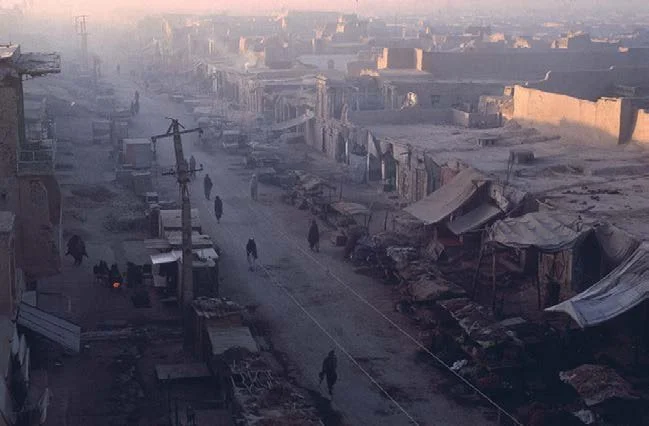
AFGHANISTAN. 1992. Kandahar dusk. ©Steve McCurry/Magnum
Spatiality and the juxtaposition of various symbols are key to constructing meaning in the rugs. Physical landscapes operate in a similar way, as natural space becomes a social space when boundaries are defined and meanings are attached to it.Spatial politics largely contribute to identity formation and systems of trade, connecting a nation’s own identity to its relationship with external networks. In the situation of Afghanistan, contemporary imposed borders compromised the fluid identity that once existed and implicitly affected systems of trade that once thrived in the area. What was once a vibrant space of trade and prosperity during the fluid age of the Silk Road was reduced to a land-locked country antagonized by different agendas over resource entitlements and distribution. The attempt to map out meaning transforms in the physical landscape, as divides made along social lines become demarcations for identity, power, and ownership.
Afghanistan has struggled to build a national identity that globalism demands, which is visible in the jarring yet neutralized narrative of these war rugs. The reason for this in due largely in part to its strategic location. Afghanistan has long stood as a space of contention for both external agents and its own diverse internal population. It has served as a site for several proxy wars, including the Cold War between the USSR and the US, and was even used as a buffer space and military resource by the British empire after two failed attempts to colonize them. Some attribute the current situation of Afghanistan to the borderline negotiated and drawn by the British in 1919, known as the Durand Line.
This border divided the nation’s ethnic majority, the Pashtuns, who had existed in the region for several thousands of years and stripped them of access to the Arabian Sea, cementing them as a land-locked country. The Taliban later mobilized these divided and marginalized groups both in Pakistan and Afghanistan to join their forces.To this day, the border is contested by the nation’s political officials, with the former president Hamid Karzai even publicly refusing to recognize the line.9 The disregard of the border heightens tensions between Afghan-Pakistan relations, but also marks the extent that Afghanistan challenges globalist attempts to map and define spatial contexts.
Plainly put, Afghanistan’s current situation highlights a struggle to adapt to global systems and reveals the adverse effects of standing in opposition to hegemony. This can be witnessed back to times of the Roman Empire with the conquests of Alexander the Great, but with relevance to the war rug that emerged during Soviet occupation it is more crucial to understand Afghan resistance over the past half century. The Soviet intervention in Afghanistan was initiated after a communist coup took hold over the country, to which communist Soviet forces arrived as backup after seeing potential in the nation’s resources and access to trade.This political tension drew into a brutal civil war following the Soviet withdrawal as internal communities fought over political control and the establishment of a national identity. After September 11, the US began its own intervention, although Afghans were entirely absent from the events that took place. The motif of the Twin Towers falling is commonly depicted in many war rugs, as the event marked a turning point for the nation in the realm of global politics and a more explicit shift in the representations found in the rugs. (Figure 2)
September 11th War Rug. 2001. Courtesy of © Australian War Memorial.
National identity and the narratives found in the war rugs coalesced along the same lines. The rug emerging during Soviet occupation highlights the political strife in the nation as a consequence of the Cold War aftermath, and depictions of paraphernalia are merely a catalog of the artillery the US left them with. (Figure 3) In relation to the development of the nation’s political and economic structure, national identity was largely compromised by imperialist interventions. With the onset of US intervention in 2001 and subsequent state-building enterprises, globalization practices produced network politics in the region.11 These networks are based on informal power relations, opportunism and bargaining by their members, and can undermine the formal politics of the state. Through such neo-colonial state building practices and hegemonic procedures, western imperialist attempts have done little more than rupture the identity of the state, challenge existing tribal codes, and antagonize local communities. It is no guess as to why they choose to intervene. It’s a tale as old as colonialism - they are after the resources the region is laden with and hope to create a market for their own goods.
Figure 1. Najibullah Afghan Civil War Rug. Photo by Kevin Sudeith. warrugs.com.
Figure 2. World Trade Center War Rug. Photo by Kevin Sudeith. warrug.com.
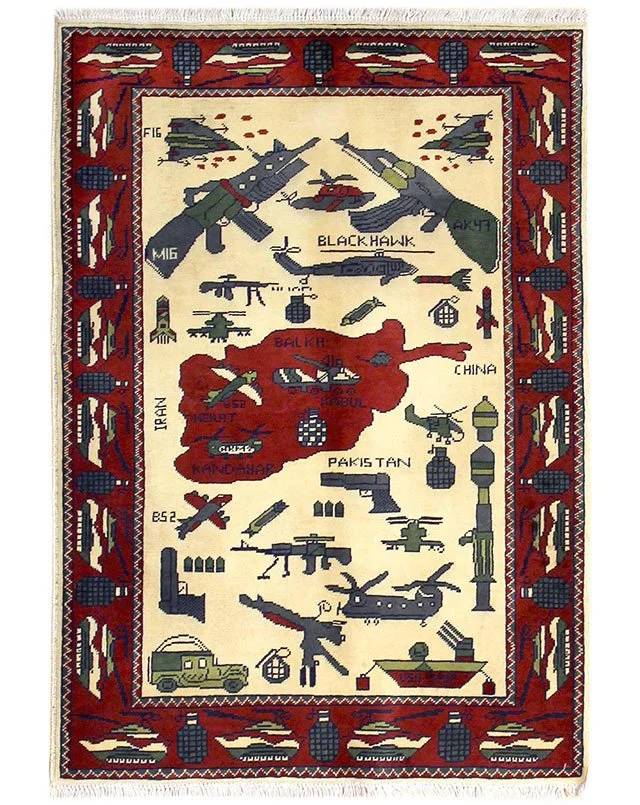
Figure 3. Photo by Kevin Sudeith. warrug.com.
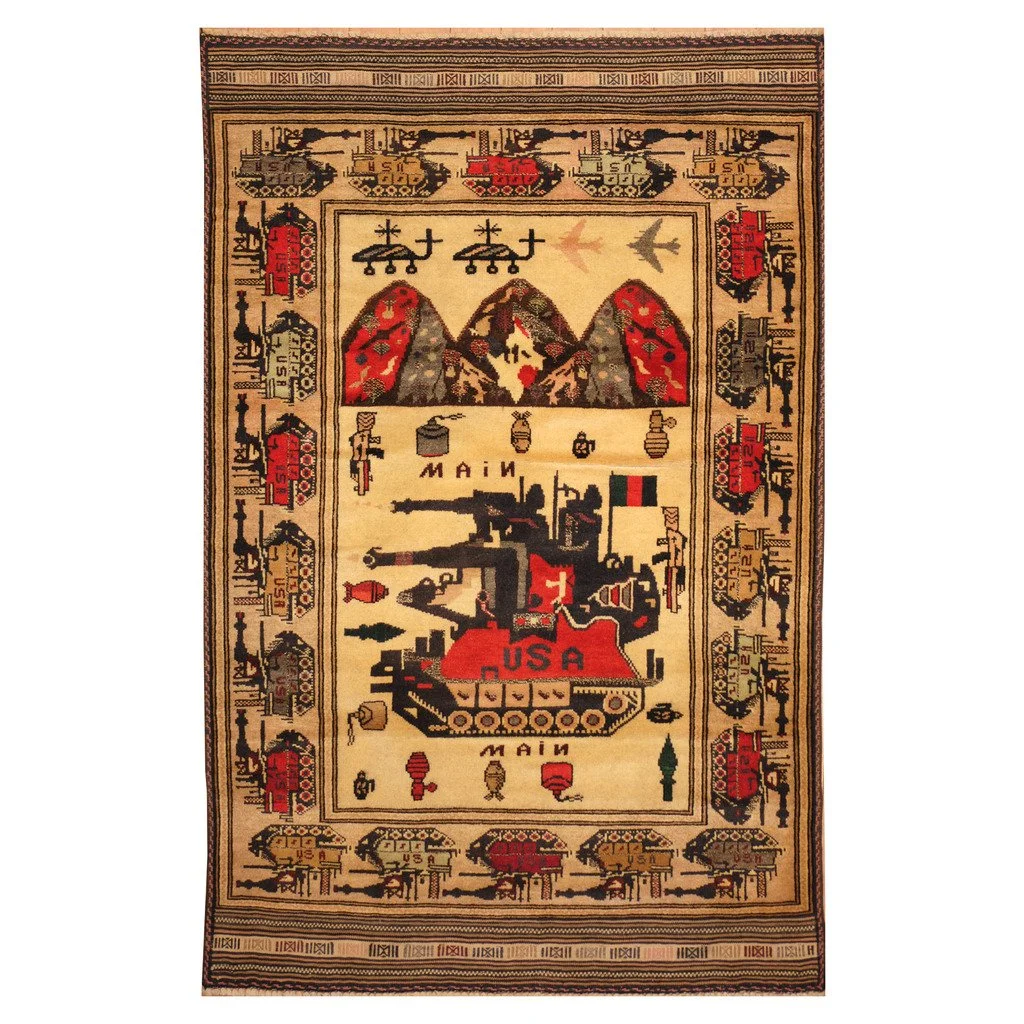
Figure 4. Afghan Hand-Knotted Wool War Rug. Courtesy of heratorientalrugs.com.
According to the UNDP’s Human Development Index, Afghanistan is one of the poorest countries in the world. The Afghan economy has experienced dramatic changes since the Second World War. It has transformed in recent years to become almost entirely dependent on International Aid and a booming illicit drug trade, both of which perverted previous cultural traditions that held together the moral fabric of Afghan society. Afghan codes of hospitality that once protected impoverished members of the community and created mutual support began to dissolve under globalization and political interventions made through the guise of humanitarian aid. As a consequence of both the Bonn Agreement and later US staged interventions, the nation developed a system of neopatrimonialism – with the nation forming a dependency on outside agents with their own agendas, while local communities formed a dependency on their unstable and underdeveloped state power.
Being severed from the international market means that those who gain income from craft traditions have little access to these networks, and therefore must depend on foreign agents to support their trade. Interaction with the global market is not uncommon for Afghanistan; trade is a part of the region’s tradition.16 However, the rise of globalization has transformed the networks of trade and situates privileged actors based on their access to capital and political stance. Atop this, the risk associated with generational conflict and instability poses a disincentive for investors that dissuades them from associating with the nation.17 The departure of international presence presented a serious shock to the economy and limited access to international trade markets. As demonstrated, global practices influence the war rugs from conception to distribution.
In respect to the culture of the economy, it is important to understand that trade networks are an integral part of both the collective and individual identity in Afghanistan. The nation has a highly informal economy, with 80% of total economic activity existing outside the reach of government economic policies and programs. It is primarily an agriculture-based economy and relies on small-scale informal trading within the nation and with its neighbors.19 With the introduction of a war economy, this complicates the interests between local and global actors. At the global scale, entrepreneurs drastically benefitted from the bubble that the war economy created, with hopes for an even higher payout from the resources of the country.20 But at the local scale, sustenance is of primary importance. Rather than producing or participating in military expenditures, Afghans tap into the commodification of war through the production of these small war rugs - trading art over arms.
The manifestation of the woven art form takes root in a longer tradition of trade, religion, and cultural practices. Textiles have been one of the most important traded commodities in both global history and in the context of Afghanistan; reaching to pastoral nomads, small villages, agricultural communities, and urban workshops. In former times, textiles were among the most valuable items in the Islamic world.22 It is an artform that holds a practical function, even so far as offering spiritual protection or harm when inscriptions and symbols are included, while also obeying the values of Islam that reject iconography and the depiction of the human form.
Carpets in particular have been notoriously significant in Islamic cultures and traditions. Afghans have a special relationship to carpet making both economically, as longtime producers, and culturally, as a society with nomadic origins. The carpet is an architectural feature that is integral to the making of a space, serving as a marker that differentiates the home from the outside world. While at the same time, the portability of its design and ability to adjust to any space mirrors a cultural mindset of fluidity and adaptation. This notion of fluidity is crucial to understanding a landscape that is perpetually in flux.
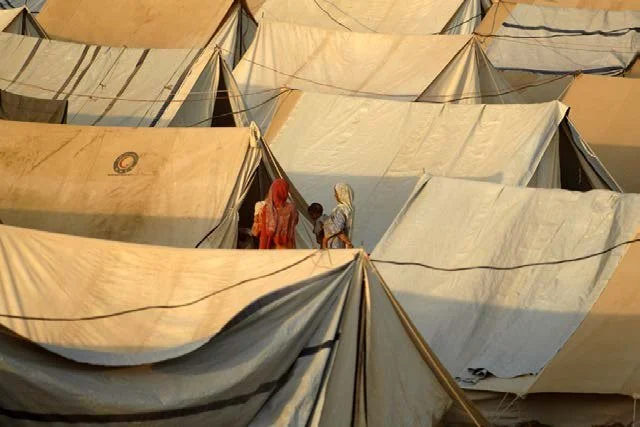
Refugees from Swat district shelter in the Swabi Refugee camp. © Jeroen Oerlemans / Panos Pictures
Defining culture is a huge problematic for the state of Afghanistan. The region is home to multiple ethnic groups; with struggles for power and representation making the arena of culture a highly contested space. Atop this, Afghanistan has suffered enormous human displacement, having the second largest refugee population in the world, pushing these identities to the fringe of refugee camps. This created an erosion of human capital and cultural traditions, as displaced people lose access to the environments that offered them this knowledge. These refugee spaces also became the breeding grounds for the anti-modernist, Islamic fundamentalist, Taliban group, as frustrations with social conditions boiled into resistance movements.26 With the rise of the Taliban in 1994, strict rules governing cultural laws were enforced across Afghanistan. They banned many symbols of culture, among of which included listening to music, watching movies, videos, and television, taking and possessing photos, and creating art of any kind.27 The repercussions for violating these laws could often mean life or death, causing a complete disrupt in cultural production and development. Taliban interventions also influenced the design of carpet weaving, as they prohibited any design with birds, people, or animals which violate the strict interpretations of Islamic art that banish all representation of life.28
Atop these looming cultural implications that arose from the conflict are logistic obstacles that impede the production of the war rugs. The dilapidated infrastructure and lack of machinery make it difficult to finish cutting and sewing the rugs, or even export and trade them due to faulty transportation and banking systems. Thus, they are unable to be produced in Afghanistan. Instead, the war rugs are assumed to be produced by Afghan women weavers in Pakistani refugee camps. Essentially, displacement and political shifts have severed weavers from their cultural practice and caused multiple disruptions to the craft.
Close to two million handmade rugs reach the international market every year from the region of Afghanistan. In this highly saturated market, weavers had to get innovative in order to have an edge in the international arena. Thus, cultural production began to respond global interests and a fascination with the conflict. The nation had already been reduced to a war-torn state by the global community, the War Rugs simply embrace this international perception. As a result, iconographies of war grew into a sort of pop cultural phenomenon by those haunted by their daily lived experience of it. The sensationalization of these images overshadow the quality of the designs and cater to a particular novelty, changing the dynamics of consumer and producer relations.
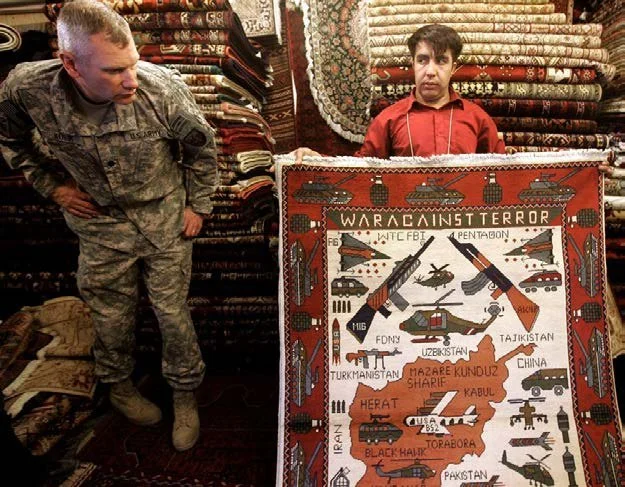
Zulmai, an Afghan Carpet seller, displays his "war rug" featuring a variety of weapons to Army Lt. Col. Chris Kubik at his shop in Camp Eggers, the U.S. base in Kabul, Afghanistan, Thursday, March 12.Rafiq Maqbool / AP
It is important to note that Afghans don’t purchase these rugs, they are most commonly bought by soldiers, who see the potential for accumulated value, or critics of war. This marks a shift in rug connoisseurship, where both the community and standards of the market have been radically transformed. The chain of intermediaries that the rugs pass through disconnects the consumer from the producer and ultimately leaves the interpretation of the rugs to the viewers perspective. Due to the visual accessibility, along with its portability, the rugs are able to traverse these disparate landscapes. Some notable traders include Kevin Sudeith, a Brooklyn based artist and owner of warrugs.com. Despite being a white American man, Sudeith has gone as far as trademarking war rug designs and has been known to file lawsuits against other white American resellers. As mentioned before, weavers are said to be women who come from impoverished refugee communities, simply trying to survive and escape the entrenches of the Taliban and the snares of the US war.
The weaving of these rugs mirrors the weaving of these grander political and economic entanglements, which have transformed the fabric of Afghanistan into one completely saturated in war. The nation has endured nearly five decades of war in the contemporary era, and has been experiencing political unrest since the early 19th century. Hundreds of thousands of Afghans have been killed over the course of these wars, the figures of which are unfortunately grossly underreported and undocumented; while millions have been displaced.
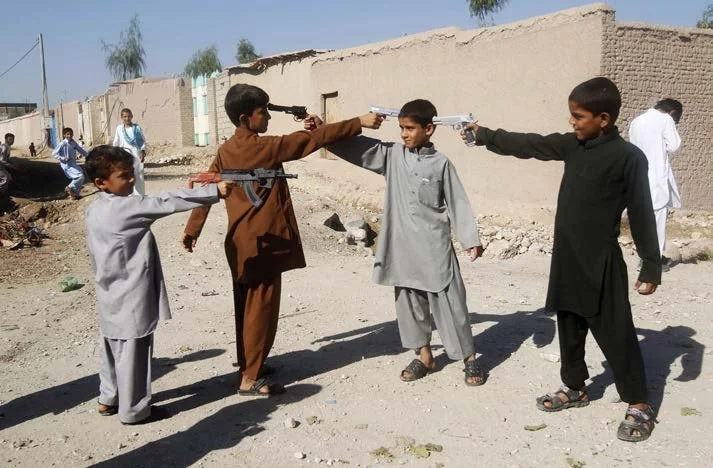
Afghan boys play with toy guns on the first day of Eid al-Adha in Jalalabad October 15, 2013. REUTERS/ Parwiz
War for Afghans is no longer a transient state. Increasingly cemented globalization practices have made the situation permanent as local and global powers refuse to budge over their beliefs, and the unfortunate reality is that innocent civilians are the ones who continue to bear the brunt of the aftermath. War is ingrained into the psyches of the people as they are trapped in a struggle they cannot escape. Whether they submit or continue to persevere, there is always an enemy at the door –in their backyard, at the border, and abroad. The rugs capture the images of war that have been permanently ingrained in the fabric of Afghan society and the spirits of its people. They function as both a contemporary folk art and document of history. The cultural relevance of these pieces humanizes the population and their experience of war by bringing it directly into the viewership and homes of the communities that have torn their worlds apart.
